Category Archive for: arts and culture

why free Ericson Acosta

Ninoy Aquino and Ericson Acosta might seem light years away from each other, and yet i’d like to think that more than what makes them different, what carries weight here is what makes them the same.

illegal detention, trumped up charges, a military blinded by getting some “big fish” and not getting enough of the red scare, being forced to face your accusers everyday, being removed from and having limited access to the outside world, being treated like some dangerous criminal, in the process making you feel less and less like yourself.

look at the timeline of Ninoy’s detention here and here, and the timeline of Ericson’s detention here.

now the hunger strike.

in April 1975, Ninoy went on a hunger strike, and in a letter addressed to Cory, his mother, his children, his sisters and supporters, explained why. Ninoy’s said:

<…> “when the Military Commission suddenly made a complete turn-about and forced me, against my will, to be present in proceedings which are not only clearly illegal but unjust, I said I shall have no other alternative but to go on a hunger strike in protest against a procedure that is intended to humiliate and dehumanize me, considering that all they wanted was for me to be identified as a common criminal, and not only for myself but on behalf of the many other victims of today’s oppression and injustices.”

on December 3 2011, Ericson began his hunger strike. detained artist since February 13 2011, Ericson was arrested without a warrant by the military in San Jorge Samar, at 10AM. he has been kept in the Calbayog Jail since then, on the false charge of illegal possession of explosive – a hand grenade which was planted on him and which the military says he attempted to take out of his pocket (in broad daylight?!?) during his arrest.

From February 13 to February 16, Ericson was not allowed to contact his family or his lawyers, and in those four days, he was not only illegally detained, he was also moved from military detachment to PNP headquarters to the hospital to the Calbayog Hall of Justice. for four days no one knew what was going on with Ericson.

for the past 10 months he’s been in jail. Ericson says:

<…> “it is utterly baseless to undergo a full-blown trial for this trumped-up charge <…> instead, i should have the right to charge the state elements responsible for violating my human rights.”

his hunger strike is also a demand for the

<…> “pull out of the highly irregular if not illegal presence of a squad of military men near Ericson’s place of detention. A platoon of soldiers from the 87th IB were first deployed in the nearby barrio in July on the pretext of military operations, but it has become apparent that the soldiers are there to “guard” Acosta.”

it goes without saying that Ericson’s hunger strike is also his demand for immediate release.

and lest you think I am dreaming here, what PNoy said last year resonates for Ericson’s case:

“We recognize that their right to due process was denied them. As a government that is committed to the rule of law and the rights of man, this cannot stand. Therefore, I have ordered the DOJ to withdraw the informations filed before the court.”

his then Executive Secretary Paquito “Jojo” Ochoa Jr. also said “questions raised on the legality of their arrest justify their release.”

PNoy was talking about the Morong 43. also illegally detained, also with trumped up charges of illegal possession of firearms and explosives, also denied due process. last year, PNoy ordered all of them released in time for Christmas. he also said:

“Let this be a concrete example of how our administration is working in the broad light of day to build a country where the law protects us equally. The culture of silence, injustice and impunity that once reigned is now a thing of the past.”

and lest this isn’t enough to justify the release of Ericson, the voice of Ninoy might help. he was after all also political detainee, turned gaunt and sick by a hunger strike that was not just a demand for his release, but the release of so many others like him, as it was about shining a light on the system of warrantless arrests and impunity.

“But peace and order without freedom is nothing more than slavery. Discipline without justice is merely another name for oppression. I believe we can have lasting peace and prosperity only if we build a social order based on freedom and justice.” – Ninoy’s letter to the military commission, August 1975, in Ninoy Letters.

“I believe that freedom of the individual is all-important and ranks above everything else.” – Ninoy, “A Christian Democratic Vision” in Testament from a Prison Cell.

i cannot claim to be friends with Ericson, but i can claim to be a fan: in my undergrad years in U.P., his was a voice that was always loud and clear, but also very human and grounded, intelligent and creative. i never thought about his freedom because i presumed he would always have it. when he lost it, i found that his illegal detention meant a palpable silence to me, no matter that he’s been blogging and singing (here and here), no matter that i had lost touch anyway with the work he was doing after U.P.

now on his hunger strike, Ericson’s struggle as cultural worker turned political prisoner shines a light on the fact that all this time, since his detention, what was always on the line was not just his life. it’s also always been our freedoms — as writers and journalists, as cultural worker of any kind.

it seems to me really, that we owe it to freedom to demand for Ericson’s release.

The (Un-)Worth of Words*

Because there are no words, none worth using to talk about the Ampatuan Massacre, no words worthy of lives lost to such violence, to such power. What we should’ve been was out on the streets, angry, fearless, pointing a finger at (giving the finger to) the system that has been feeding private armies. But none of that happened. Instead we were quiet and enraged, watching the news at home, receiving word about the rumored real reason behind the encounter, which involved anti-Muslim Christian-biased notions of multiple wives and girlfriends and patriarchy.

We were more dead than those 57 people, double-dead because we knew this possible but we waited for it to happen. What can only be worse than that is having illusions about our words being worth anything.

This is my issue with the Anthology of Rage in Verse I. It isn’t even an illusion of change that’s here as it is a notion that it matters at all to anthologize 100 poems, with no titles and just poets’ names, collecting rage about the Ampatuan Massacre into one epic poem by various contributors. It’s no surprise that this notion of continuity is possible, because there isn’t much to look at here, not much to read as far as diversity’s concerned. Because whatever the individual perspectives (which tend to speak generally of grief/anger/brotherhood/hope(lessness)/rising from the ashes) the tendency at romanticizing the death of 57 seems all-encompassing, is really quite the default.*

This is easy to understand given the established poets’—all of whom submitted poems—defense of the project. There is Marne Kilates’ take on the goals of this anthology, “Protest poetry or poetry against violence is an act of language. It is an instance of language engaging the physical and the experiential, as language always does in everyday speech. But since poetry is not everyday speech, protest poetry or poetry against violence brings the engagement to a higher level.” This higher level’s relationship to poetry and the Ampatuan Massacre is something that Luisa Igloria works with when she says that the murders’ effect on us all should “rightly serve as ballast and ground for the language and lyric of poetry,” where Gemino Abad’s notion of collecting “the finest rage” perfectly fits in.

But what this massacre requires, its goriness, its kabastusan is the language of the everyday. In fact, it requires the use of a language that will hurt because it screams from the gut, shoots from the hip, or is as dirty and angry as those killers were, as fearless as the Ampatuans were/are. To use what is deemed as the high language of poetry, to insist on rage that is fine, or the beauty of poetic language, seems politically incorrect. In fact, poetry such as what’s in this anthology seems politically incorrect.

Because there are many things to do other than write. If writing is your weapon, then there is writing that matters now because it will be read, because it will be relevant, because it isn’t tied up in illusions of beauty and lyricism, highness and artistry.

Because what is relevant, always is. This is why we go back to the Lacaba brothers’ Martial Law poems. This is why we go back to the protest songs, to the songs of the revolution, to poems of nation. This is why books likeDekada ’70 by Lualhati Bautista and State of War by Ninotchka Rosca continue to be reprinted, year after year after year; this is why the Noli Me TangereEl FilibusterismoFlorante at Laura are deemed national literature required in classes across the country. It is because while it speaks of a different time, it speaks of us now. It is because the reasons for rage against the Ampatuan Massacre have been with us forever, have been here since government ceased to be effective, since families across the country were allowed to keep positions of power, regardless of how.

Real relevant protest literature reminds us of how dangerous the pen is and puts fear in our hearts as we write it. It is here that there is bravery and courage in the act of writing; it is here that there is an amount of danger. Real protest literature is a threat to the always oppressive status quo, it’s something that any tyrant will fear enough to judge it worthy of declaring the suspension of rights to expression.

At the height of relevance, writing in protest puts our lives in danger, it is enough to get us jailed.

Kilates says that it’s possible that “we can never exhaust the subject of violence with impunity and too much random death.” True, but why would we want to? Write about violence when we can do something about it, I mean. When what the Ampatuan Massacre should’ve told us was that all our words that condemn oppression, all our literary work that questions the status quo, ends up being nothing but the status quo because it refuses to be more than just those words, because it is repeated as a mantra, it is celebrated as “the word”, fine and otherwise, and nothing else. It is an end point: this is what I’ve got to say therefore this is what I’ve done.

Luisa Igloria quotes Brecht, “In the dark times, will there also be singing? Yes, there will be singing about the dark times.”

Two hundred five.
One thousand one hundred eighty-eight.
One thousand nine hundred sixty-three.

These are 2001 to 2009 numbers of victims of enforced disappearances, extrajudicial killings, and illegal arrests. These are bigger, more urgent numbers, than 57. Where have our poets been through these dark times? Or was the past decade not dark enough? Maybe this was a choice not to speak, not to empathize, not to rage all this time?

Maybe if there was rage then, the Ampatuan Massacre wouldn’t have happened. But then again, that’s giving poets—all of us writers—too much credit. Merlie Alunan says, “<…> let the words flood among us, into us, to grieve, to rage. Maybe to heal this wounded nation.” Ah, but the words that heal this nation don’t come in poems with high language, doesn’t happen on the internet, doesn’t come in any anthology of literary works. It happens on nationwide television, when the media-created messiah says we will be alright, and thousands of the oppressed believe him. There lies the change that disregards our words.

And why there is always reason to rage against the words we use to explain our world. Unless these can kill in the way guns and money and power can, they are nothing but unworthy.
———

Only poems in Filipino and English were read by this reviewer.

Quotes from poets via the comments section of Marne Kilates’ and Joel Salud’s individual Facebook notes defending the anthology.

Data via Karapatan’s 2009 Human Rights Report.

*this was written for High Chair’s 12, 2009-2010, which dealt with the Maguindanao Massacre, the 2nd anniversary of which is today. Read the rest of the High Chair issue here and here and here.

Rodel Tapaya WINS!

Grand Prize, Signature Art Prize 2011!

that’s out of 130 nominated works and 15 finalists from the Asia Pacific.
and no, this prize isn’t the one based on people’s votes ha.

wherefore art thou Pinoy pride?

Baston ni Kabunian, Bilang Pero di Mabilang
(Cane of Kabunian, numbered but cannot be counted)

image from here.
more info up at the Singapore Art Museum FB page.

on Manolo Sicat’s Matayataya

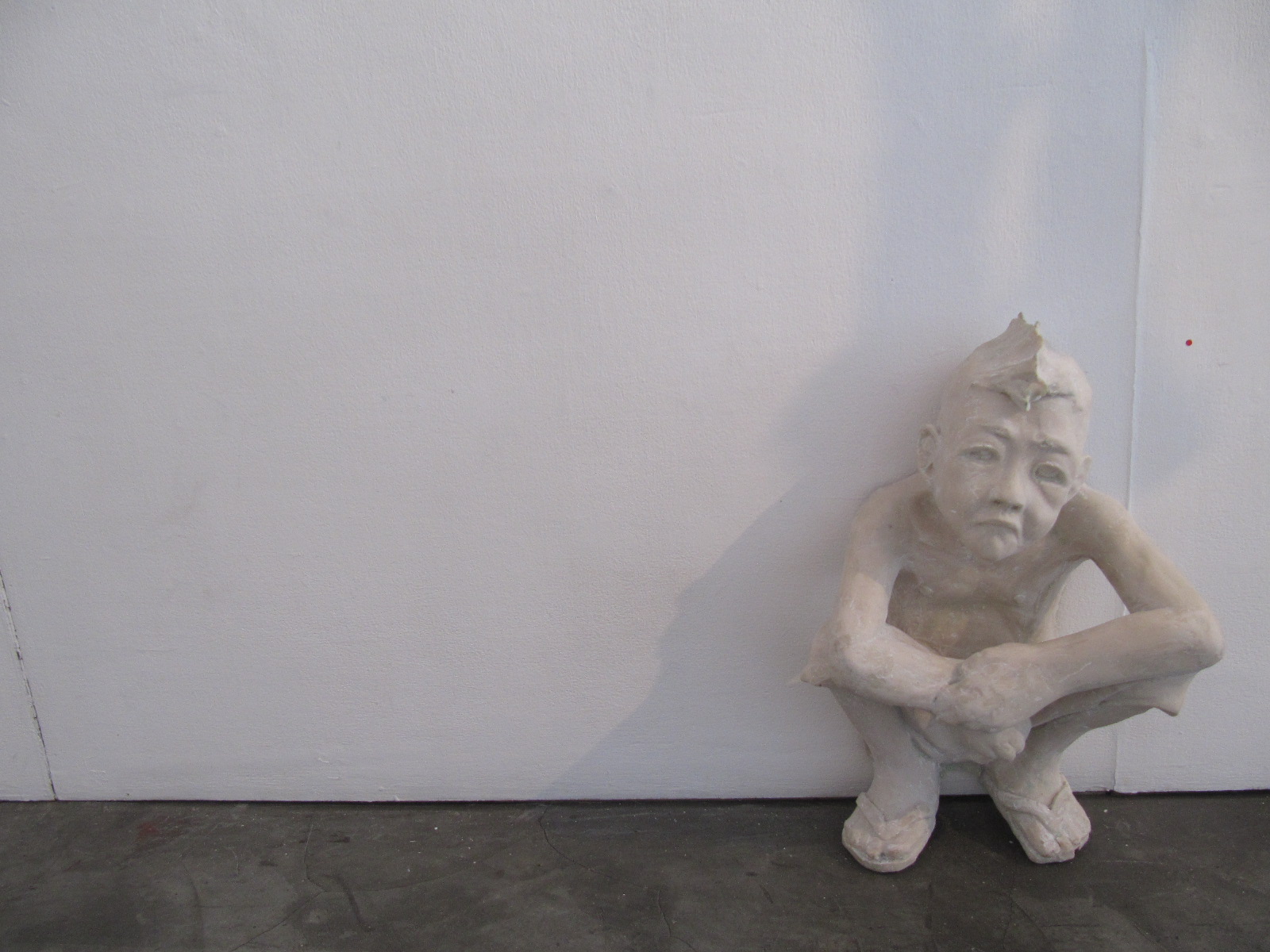
Manolo Sicat's "Bawal Tumayo 1"

White is what greets you when you enter the gallery that’s been transformed into a playground by Manolo Sicat’s Matayataya. The first reaction is one of joy: the kind that play allows, no matter how old we get, especially because it is reminiscent of the kids that we were when the streets were safe to play in. But it sinks in soon enough: play here is everything and violent, because the streets have changed, because the streets are now testament to what has become the sad state of an impoverished nation.

To say that this exhibit is just about the violence of poverty wouldn’t do Sicat’s work justice. In fact it isn’t so much poverty as it is inequality, it isn’t so much inequality as it is injustice, it isn’t so much what’s unjust as it is how all these tie together into sadness and helplessness when children – and all that they represent – are objects and subjects.

The cold cast marble sculptures of Matayataya are precisely such: children at play are its necessary subjects, made into mere objects by the contexts within which they live.

click here for the rest of it!

TEDx Talks are independently organized TED talks across the world, which is about “riveting talks by remarkable people.” TEDx Diliman was my first. This is a review of each of the TED talks that were part of it, done in 18 minutes or less, because that’s the time limit of a TED Talk. Read more about TED here, and check out this really good video on TEDx here.

Fernando Sena: How to draw an eye

with all due respect to someone who “needs no introduction, as his influence as a teacher has touched the lives of some of the most acclaimed and sought after artists today” (via Sena’s youtubevideo caption).

teaching us literally how to draw an eye? towards in the end promoting one’s art classes and one’s own son.

que horror.

the only thing worse than Sena’s TEDx Diliman talk was Nina Lim-Yuson’s talk: 18 minutes or so of shameless self-promotion of Museo Pambata projects.

both beg the question: wherefore art thou ideas worth spreading?

and really. what a waste of time.