let’s begin with the fact that this video/docu was well done, shall we? it’s 15 minutes, with more information than we get out of a regular TV documentary, had no voice over, had short effective copy, great animation, a clear narrative line. and the best questions: who are the Cojuangcos, why have they gotten away with murder — literal and figuratively — in this country?
that it has gone viral, which is to say its hits are at 337,048 as we speak, is no surprise. the form allows for it, the content even more so. there is no way to measure how many of those hits actually mean people changing their minds about the Cojuangcos or how many brush it off, how many believe it and how many look for sources and say, ah, these are all lies.
the point being that in this age of texts made for online dissemination, in this age of social media, while much might be said about putting our names on everything we write, there is also the fact that sometimes it matters very little because what’s being said is more important, the discussions it forces on us are bigger than who said what and why. and isn’t it that in the end the parts that are factual, the story that is hacienda luisita, the fact of oligarchies and feudalism, the fact of government’s inability to deal with both, aren’t these parts of that video that are more relevant than the parts that have yet to be proven?
granted, this was a telling of history that was slanted. but whose history telling isn’t? we disproved objectivity a long long time ago and in the end we deal with the subjectivities that are intrinsic in texts we encounter, historical and otherwise. in the age of online media and viral videos, every text requires us to be responsible and discerning. we must deal with questions of why we share what we do, and how we respond to something that’s being watched by more people — the youth, especially — than we have readers.
now with regards the latter, and i say this with all due respect, it seems unproductive for xiao chua to riddle his response to the video with: i’ve written about this before and this is nothing new. that information exists doesn’t necessarily mean it will be read, and in the end, when we are up against a well-done fast-paced video, the notions of leaving things up to the courts, or asserting that there are two sides to a story, will just go over the heads of those who were already drawn into the narrative. we fail to engage them in a better discussion on history in general, and the Cojuangco question in particular. it also ends what should be the beginning of a discussion on history and propaganda, fact and fiction, and where those lines need to be drawn, if at all.
but more problematic might be the noise that followed this video’s going viral, at least in so far as noise has to do with the self-proclaimed guards of online media and twitter- and FB-kind.
randomsalt asked momblogger: is blogwatch now in the business of spreading pseudo-history? after the latter posted the video on the site. to which momblogger replied that she was in the business of spreading both sides which is why she got xiao chua to respond to the video and posted that response, too. (click here for the rest of the exchange.) what interests me about this exchange though is the fact that momblogger herself proves that she cannot see her own biases, the slant that she takes, when she introduces the video with:
Thou shalt not be ignorant. Infamous facts about the Aquino-Cojuangco family. I found this video from the PinoyMonkeyPride youtube channel. He writes the following disclaimer below. You might be also interested to read Philippine historian Xiao Chua’s initial Comments and Anton Dulce‘PinoyMonkeyPride’, ‘Yellow Magic’, at ang Magkabilang Panig ng Parehong Pisoafter watching the video.
this video, whether psuedo-history or not, should not be equated with making us all less ignorant. in fact, as unsigned online video, it is everything and dangerous to say that these are “infamous facts about” something. to say “you might also be interested” versus “do watch” all responses to this video, is also momblogger’s subjectivity working against her insistence that she was being responsible when she put that video up.
the only thing worse than momblogger’s denial of her own biases, is the manner in which she handled the questions from randomsalt:
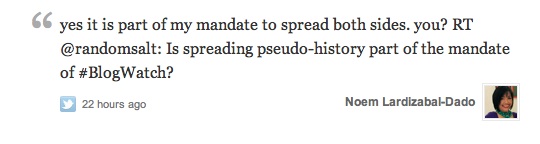
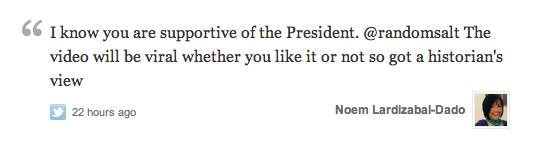
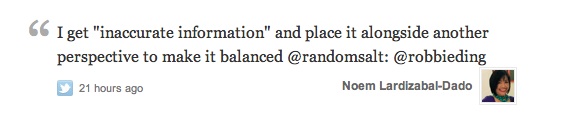
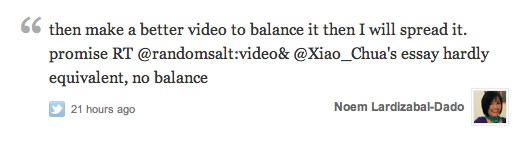
it is beyond me how inaccurate information can ever be balanced, nor how an anonymous video such as this one can be seen to come from just one side which makes another side identifiable. here, what momblogger proves is that when faced with a video that goes viral, she will go the way of the very simplistic, ultimately uncritical assessment of the text, while at the same time thinking that she is objectively disseminating facts, even as her own subjectivities are there for all the world to see. and she will take offense at being questioned, even as we all know this is the price you pay for making a career out of online media.
meanwhile, these questions remain given a video with historical fact and inaccuracy, but issues that remain relevant, gone viral: what is our responsibility here? what is it that we end up doing by the act of sharing? how do we respond? what do we do when someone argues with us about what we said or did?
momblogger did the most juvenile thing: she blocked randomsalt.