Category Archive for: media

let’s begin with the fact that this video/docu was well done, shall we? it’s 15 minutes, with more information than we get out of a regular TV documentary, had no voice over, had short effective copy, great animation, a clear narrative line. and the best questions: who are the Cojuangcos, why have they gotten away with murder — literal and figuratively — in this country?

that it has gone viral, which is to say its hits are at 337,048 as we speak, is no surprise. the form allows for it, the content even more so. there is no way to measure how many of those hits actually mean people changing their minds about the Cojuangcos or how many brush it off, how many believe it and how many look for sources and say, ah, these are all lies.

the point being that in this age of texts made for online dissemination, in this age of social media, while much might be said about putting our names on everything we write, there is also the fact that sometimes it matters very little because what’s being said is more important, the discussions it forces on us are bigger than who said what and why. and isn’t it that in the end the parts that are factual, the story that is hacienda luisita, the fact of oligarchies and feudalism, the fact of government’s inability to deal with both, aren’t these parts of that video that are more relevant than the parts that have yet to be proven?

granted, this was a telling of history that was slanted. but whose history telling isn’t? we disproved objectivity a long long time ago and in the end we deal with the subjectivities that are intrinsic in texts we encounter, historical and otherwise. in the age of online media and viral videos, every text requires us to be responsible and discerning. we must deal with questions of why we share what we do, and how we respond to something that’s being watched by more people — the youth, especially — than we have readers.

now with regards the latter, and i say this with all due respect, it seems unproductive for xiao chua to riddle his response to the video with: i’ve written about this before and this is nothing new. that information exists doesn’t necessarily mean it will be read, and in the end, when we are up against a well-done fast-paced video, the notions of leaving things up to the courts, or asserting that there are two sides to a story, will just go over the heads of those who were already drawn into the narrative. we fail to engage them in a better discussion on history in general, and the Cojuangco question in particular. it also ends what should be the beginning of a discussion on history and propaganda, fact and fiction, and where those lines need to be drawn, if at all.

but more problematic might be the noise that followed this video’s going viral, at least in so far as noise has to do with the self-proclaimed guards of online media and twitter- and FB-kind.

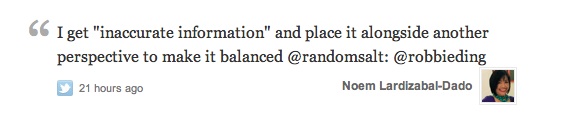
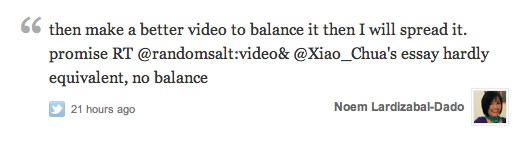
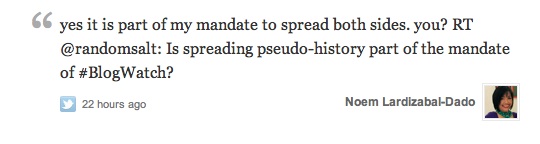
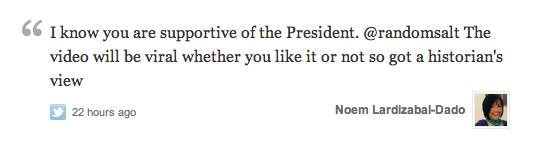
randomsalt asked momblogger: is blogwatch now in the business of spreading pseudo-history? after the latter posted the video on the site. to which momblogger replied that she was in the business of spreading both sides which is why she got xiao chua to respond to the video and posted that response, too. (click here for the rest of the exchange.)  what interests me about this exchange though is the fact that momblogger herself proves that she cannot see her own biases, the slant that she takes, when she introduces the video with:

Thou shalt not be ignorant. Infamous facts about the Aquino-Cojuangco family. I found this video from the PinoyMonkeyPride youtube channel. He writes the following disclaimer below. You might be also interested to read Philippine historian Xiao Chua’s initial Comments and Anton Dulce‘PinoyMonkeyPride’, ‘Yellow Magic’, at ang Magkabilang Panig ng Parehong Pisoafter watching the video.

this video, whether psuedo-history or not, should not be equated with making us all less ignorant. in fact, as unsigned online video, it is everything and dangerous to say that these are “infamous facts about” something. to say “you might also be interested” versus “do watch” all responses to this video, is also momblogger’s subjectivity working against her insistence that she was being responsible when she put that video up.

the only thing worse than momblogger’s denial of her own biases, is the manner in which she handled the questions from randomsalt:
momblogger1
momblogger1
momblogger2
momblogger2
momblogger3
momblogger3
momblogger4
momblogger4

it is beyond me how inaccurate information can ever be balanced, nor how an anonymous video such as this one can be seen to come from just one side which makes another side identifiable. here, what momblogger proves is that when faced with a video that goes viral, she will go the way of the very simplistic, ultimately uncritical assessment of the text, while at the same time thinking that she is objectively disseminating facts, even as her own subjectivities are there for all the world to see. and she will take offense at being questioned, even as we all know this is the price you pay for making a career out of online media.

meanwhile, these questions remain given a video with historical fact and inaccuracy, but issues that remain relevant, gone viral: what is our responsibility here? what is it that we end up doing by the act of sharing? how do we respond? what do we do when someone argues with us about what we said or did?

momblogger did the most juvenile thing: she blocked randomsalt.
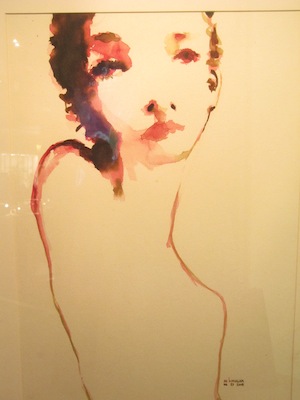
and how art criticism fails in this country. stop talking to the artists! start looking at their work!

"Pure" by Martin Honasan

The endless gaze in Digging In The Dirt

In literature we always say the author is dead, a convenient and highly questionable concept really that allows the reader a pretense of reading only the text, ignoring as much as possible the notion of the writer as center of truth. In reviewing art, it still seems like a contradiction to do an interview with the artist in relation to a new work; always this means falling into the trap of making him explain himself.

This is what’s working against Digging in the dirt, an exhibit that’s interesting enough to talk about extraneous to who the artist is – or what that name holds. What’s in a name, when you’ve got some art to look at really, and portraits that already demand a conversation? This is the work of Martin Honasan.

The first thing that strikes you is the breadth of the portraits that are here (and the fact that it’s in the midst of a busy mall’s hallway): from huge canvases with heavy acrylic paint to small canvases with sparse almost pen and ink sketches rendered in watercolor, from dark almost dank colors to bright yellows and reds and stark whites. Even just the heavy hand in the large canvases vis a vis the lighter hand used for the smaller work is unique in itself, especially when one considers that across these portraits are the eyes as focal point, no matter how it’s rendered, regardless of the size of the work.

Read the rest here!

Let it be said that Superstar Nora Aunor’s comeback is by all counts a success, if we are to measure it not by media mileage or product endorsements, not by tell-all interviews in every darn showbiz talk show or by grand statements about home being where the heart is.

Ate Guy’s return has been about none of this and that is precisely a measure of this comeback’s success. Because would she be the unbeatable popular culture icon that she is, the film actress par excellence, the Superstar in the real sense of the word, if she came back and fell into the trap of showbiz as created by the Kris Aquinos of this world?

Not at all. Ate Guy is everything that contemporary showbiz is not. And that was true long before she left, that was real to anyone who saw her films and respected her daring, this was always true for those of us who couldn’t help but be astounded on the one hand, and then be downright impressed on the other, by the life choices she was making, given the little that we actually knew of her. She was rebel long before it became fashionable to be one, she was rakenrol like no other, and in the midst of that she was inadvertently pointing out that she was – should be – nothing but actress, but singer, but star.

Ate Guy might be the only icon on these shores who can say to her public: here’s who I am, deal with it.

click here for the rest of it!

it’s been quiet here, which isn’t to say that it’s been quiet where i’m at. been finishing up an MA thesis that’s gone on for too long, and is more about closure to a life lived in the academe more than anything else. while that’s happening, i’ve had more interesting conversations than usual, including conversations about art and the state of things in this country, ones that are kept off the record, unspoken of. sometimes it’s limited to Facebook, other times it just refuses to engage in decent debate and discourse, distinct from the personal.

yet there are many things to write still, conversations to be had. but it seems even brave statements of distrust and disgust, even ones that are relevant and worthy of discussion, become feed and fodder for the personal. here lies our un-critical dead end: we are a sensitive bunch of people, very few of us can handle criticism. yet in times of controversy, or just given the space to do it (blogs, newspaper columns), everyone becomes a critic in this country, everyone will claim the title.

which is fine too, were we all working with a sense of what criticism requires, what it entails, what it must necessarily work with. in recent conversations, forced to answer questions about the work i do, the blogging and the writing, and therefore my life in general (hah!), i realized that much of what i had to say reverted back to my sense of what’s relevant and important, to a sense that what i say is secondary to that text that’s in front of me, which is also always a text that’s about nation. i will never claim that i get it right all the time, or even half the time; but i will say that i come from a very clear sense of myself as spectator in the context of the tragedies and sadnesses that are in this space we all inhabit, that any cultural text necessarily sprouts from, no matter how removed these might be.

and just in case it isn’t clear, i’d like to think that any critic is a writer first, because every critic lives off of words, too, lives off of choosing the right words for capturing how she has experienced a text. and as with any writer, the only way to have the words to say, and to have a sense of what’s relevant to discuss, is to be within the enterprise of culture in this country, half the time suspending one’s notions of taste and order, the other half suspending all judgement. all the time it requires this sense of how things are never black and white anymore, that these are gray times, where notions of power and oppression are interspersed/diluted/interlaced with things that are prettier or tastier or just downright addictive.

it’s because of this that i find generalizations to be painfully unfair, if not just usually absolutely wrong. after the success of Ang Babae sa Septic Tank, this generalization was dropped —

Before it got made in the mainstream though, Ang Babae sa Septic Tank won over the less-forgiving indie film crowd, comprised mostly of hipster students and educated artsy folk who are used to seeing gritty, neo-realist dramas and have the tendency to be just a tad pretentious.

i’d like to find out where this indie film crowd hangs out, just because this girl’s got it all wrong about the indie, and the indie film, and even just the idea that there’s a crowd. had she read up on the indie, watched the indie for the past decade or so too, she’d know that this “crowd” doesn’t exist, the hipster students she’s so critical of are a recent aspect of it (and the hipsters are everywhere), and the neo-realist dramas that tend to be pretentious aren’t at all of the indie as a category, but of a kind of Pinoy film in general, indie and otherwise.

in direct contrast to such misinformed generalizations is something as honest as pinoy drama rewind which does movie and TV reviews, as well as episode recaps of contemporary soaps and seryes. this might not be the kind of critical blog that’s celebrated, but it sure as hell’s got more going for it than the misinformed being given space(s) in broadsheets like the Philippine Star. in the latter we just perpetuate the notion that all it takes is space to write and an amount of yabang. in the former, there is an effort at actually and truly coming to terms with the cultural products that we create and live with in this country, and there is a sense of humility more than anything else.

one that we should all learn from, critic and writer, young and old, in broadsheets and online, alike.

On August 7, 2011, the History Channel premiered its 48-minute documentary on the bus hostage drama that happened in Manila a year ago on August 23, 2010.

For a full week after the premier, this same documentary would be replayed every day, sometimes three times a day, on cable TV. There was no noise about it, barely any media mileage other than what looked like press releases from the History Channel itself, where the documentary is sold along with the rest of the channel’s offerings for August.

For a nation that prides itself in having a powerful online and mainstream media, for a nation that can pick on a private citizen like Christopher Lao, and an artist like Mideo Cruz, we sure as hell know when to keep something under the radar. We sweep it under the proverbial rug, so to speak, just in case we might also be allowed to forget it. Speak no evil, see no evil, hear no evil, means we cannot be seen as evil?

In the case of last year’s bus hostage tragedy, we might not be evil, but we sure are incompetent and unforgivable, unapologetic and downright wrong. And in light of this documentary, we are just all complicit.

Were we all just too busy? Or were we all not ready for this anniversary?

the rest of it is here.