Which brings me to Pangan, who’s the best that I’ve seen him here. Without the trappings of a more complex because highly fictionalized or fantastic role, with only the seeming simplicity of a father and husband character, what’s here is pure unadulterated Pangan, and a voice that can move from optimism to helplessness to nostalgic in equal turns. But it’s in that breakdown scene that Pangan proves himself theater actor, with anguish that echoes with everything that has to do with male suffering in the hands of skillful denial, a rendering of patriarchy that we rarely see because it is so painful.
It is pain too, as it is insanity, but even more so clarity, that is in Lauchengco-Yulo’s portrayal of the complexity that is loss and grief in one woman. And when I say woman here, it is Lauchengco-Yulo as body. Her Diana moved across that stage and told this story, not just with words spoken or songs sung, but also and more importantly with movement, deliberately going against that one rational narrative line. Her frowns of confusion, her furtive steps, the questions she asks of doctor / husband / daughter, the routines she kept, the ones she forgot – all gestures not just words, all happening with the weight of her distress. And in the final moment, Lauchengco-Yulo allows Diana to clearly swing between uncertainty and control even as she makes logical the decision to favor self, the most powerful glorious moment in the whole musical, the one time the woman’s body is allowed lightness, is suffused with grace.
Suffice it to say that even just memory of the individual moments of Lauchengco-Yulo’s Diana and Pangan’s Dan brings tears, almost like a melancholia that’s always been and will always be yours as audience. Here is a brilliance that seeps into your spirit and makes you less spectator and almost co-conspirator in the story that unfolds.
let’s begin with the fact that this video/docu was well done, shall we? it’s 15 minutes, with more information than we get out of a regular TV documentary, had no voice over, had short effective copy, great animation, a clear narrative line. and the best questions: who are the Cojuangcos, why have they gotten away with murder — literal and figuratively — in this country?
that it has gone viral, which is to say its hits are at 337,048 as we speak, is no surprise. the form allows for it, the content even more so. there is no way to measure how many of those hits actually mean people changing their minds about the Cojuangcos or how many brush it off, how many believe it and how many look for sources and say, ah, these are all lies.
the point being that in this age of texts made for online dissemination, in this age of social media, while much might be said about putting our names on everything we write, there is also the fact that sometimes it matters very little because what’s being said is more important, the discussions it forces on us are bigger than who said what and why. and isn’t it that in the end the parts that are factual, the story that is hacienda luisita, the fact of oligarchies and feudalism, the fact of government’s inability to deal with both, aren’t these parts of that video that are more relevant than the parts that have yet to be proven?
granted, this was a telling of history that was slanted. but whose history telling isn’t? we disproved objectivity a long long time ago and in the end we deal with the subjectivities that are intrinsic in texts we encounter, historical and otherwise. in the age of online media and viral videos, every text requires us to be responsible and discerning. we must deal with questions of why we share what we do, and how we respond to something that’s being watched by more people — the youth, especially — than we have readers.
now with regards the latter, and i say this with all due respect, it seems unproductive for xiao chua to riddle his response to the video with: i’ve written about this before and this is nothing new. that information exists doesn’t necessarily mean it will be read, and in the end, when we are up against a well-done fast-paced video, the notions of leaving things up to the courts, or asserting that there are two sides to a story, will just go over the heads of those who were already drawn into the narrative. we fail to engage them in a better discussion on history in general, and the Cojuangco question in particular. it also ends what should be the beginning of a discussion on history and propaganda, fact and fiction, and where those lines need to be drawn, if at all.
but more problematic might be the noise that followed this video’s going viral, at least in so far as noise has to do with the self-proclaimed guards of online media and twitter- and FB-kind.
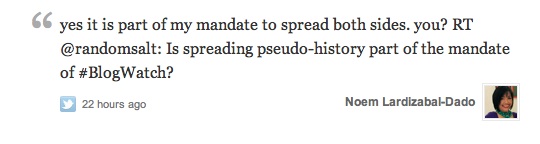
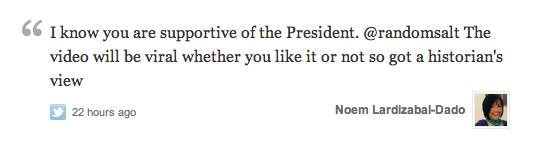
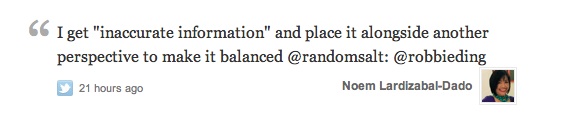
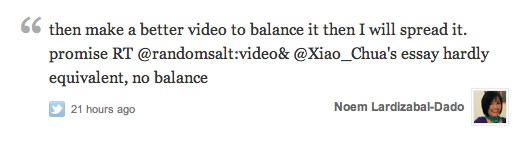
randomsalt asked momblogger: is blogwatch now in the business of spreading pseudo-history? after the latter posted the video on the site. to which momblogger replied that she was in the business of spreading both sides which is why she got xiao chua to respond to the video and posted that response, too. (click here for the rest of the exchange.) what interests me about this exchange though is the fact that momblogger herself proves that she cannot see her own biases, the slant that she takes, when she introduces the video with:
this video, whether psuedo-history or not, should not be equated with making us all less ignorant. in fact, as unsigned online video, it is everything and dangerous to say that these are “infamous facts about” something. to say “you might also be interested” versus “do watch” all responses to this video, is also momblogger’s subjectivity working against her insistence that she was being responsible when she put that video up.
the only thing worse than momblogger’s denial of her own biases, is the manner in which she handled the questions from randomsalt:
momblogger1momblogger2momblogger3momblogger4
it is beyond me how inaccurate information can ever be balanced, nor how an anonymous video such as this one can be seen to come from just one side which makes another side identifiable. here, what momblogger proves is that when faced with a video that goes viral, she will go the way of the very simplistic, ultimately uncritical assessment of the text, while at the same time thinking that she is objectively disseminating facts, even as her own subjectivities are there for all the world to see. and she will take offense at being questioned, even as we all know this is the price you pay for making a career out of online media.
meanwhile, these questions remain given a video with historical fact and inaccuracy, but issues that remain relevant, gone viral: what is our responsibility here? what is it that we end up doing by the act of sharing? how do we respond? what do we do when someone argues with us about what we said or did?
momblogger did the most juvenile thing: she blocked randomsalt.
TEDx Talks are independently organized TED talks across the world, which is about “riveting talks by remarkable people.” TEDx Diliman was my first. This is a review of each of the TED talks that were part of it, done in 18 minutes or less, because that’s the time limit of a TED Talk. Read more about TED here, and check out this really good video on TEDx here.
Aureus Solito and his search for magic
what struck me about Aureus Solito’s TEDx talk was that he was the first to do it extemporaneously, as a TED talk should be.
which is not to say that there was much in Solito’s talk that made for an idea worth spreading as is the promise of a TEDx talk. what he did in fact, was tell the story of his life as it is tied to his Palawan roots, and he spends all of his 18 minutes just moving from childhood, to elementary school, to highschool, to college, and how the stories of Palawan would riddle his years, would make him weird in school, would give him the advantage of having stories magical and real.
this was interesting for sure, but not quite what should take most of those minutes spent in a TEDx talk.
ideally, you tell these stories as context for how you’ve used those experiences of your roots and your traditions, towards coming up with some bright idea that works, something that helps in saving these traditions that you find are important to you.
this Solito suddenly throws into the mix in his last two minutes onstage, where he talks about people and nature being one, where he mentions in one quick sentence that what he does through film is to try and achieve a certain kind of magic, a certain healing, which also means warding off the evils that are apathy and mediocrity.
this was Solito’s bright idea worth spreading. this was not what he talked about in the 18 minutes that he was onstage.
one realizes: all stories might be personal, and that is well and good. but TEDx talks demand ideas. ones that might be emulated, ones that could inspire, ones that have already taken steps in changing the world. in that sense, stories are but the premise of ideas worth sharing, and without the latter, the magic Solito grew up with becomes nothing but the words in a story that’s only his, not at all ours for the taking.
TEDx Talks are independently organized TED talks across the world, which is about “riveting talks by remarkable people.” TEDx Diliman was my first. This is a review of each of the TED talks that were part of it, done in 18 minutes or less, because that’s the time limit of a TED Talk. Read more about TED here, and check out this really good video on TEDx here.
Roby Alampay on freedom is our competitive advantage
the thing with saying that the Philippines’ advantage is our freedom is that the only idea it gets across is a romance with the freedom of expression we enjoy (as exemplified apparently by having the TEDx talk to begin with, Alampay says), which of course also means limning over the fact of activists being jailed and disappeared, cultural worker Ericson Acostastill being in jail, and really begs the question: what freedom?
Alampay’s 18++ minutes (yes he was allowed) was spent talking about freedom being our competitive advantage because it can mean making the country the center not just of civil society which feeds off of freedom, but also the center of academic freedom (“Kaya namin ‘yon!” he says). both will mean generating jobs and contributing to the economy, creating an industry out of our freedom.
for Alampay, freedom is the card we can play, because, and i quote:
freedom is the one thing we do better than anybody else.
do we? really do freedom well I mean? Alampay uses the example of CCP’s closure of the Kulo exhibit (without mentioning it of course), without realizing that in fact in fact more than proving that the gov’t can just take away our freedom, that incident also proved that when we are questioned about our freedom, we have no idea how to defend ourselves. we mess it up completely: our artists, curators, cultural workers. we do not know how to defend ourselves, we do not know how to talk to media, to the people who don’t care for our art but will care about religion, and we mess it up. that is us messing up even as we are free. that is proof that we don’t do freedom well.
even more false? the idea that there’s academic freedom where we are. i’ve lived off of two universities in this country, and when you’re immersed in that manner you also know that in fact your freedoms are false in these institutions, they are limited to what is the intellectual parochialism that’s there, they are limited by the people who have been in the academe all these years.
most importantly, academic freedom, artistic freedom, freedom of expression are all highly questionable when you come from here and know | feel | see that freedom is also overrated when it cannot will not put food on people’s tables and more and more people are falling below the poverty line.
and if you live in the Philippines, you must also know — and must admit — that most of the time we are delusional about our freedom because we are middle class educated English-speaking TEDx speakers. or, as Alampay says, he’s an economy of one, dreaming.
dreams are good. but as ungrounded and unfulfilled, as romanticized and sophomoric as this? not at all worthy of a TEDx talk. but it sure sounds like something the PNoy government would love to hear.
Such as what Dalisay sees to be the “mournful wail of oppression” as the one thing expected of work from the Philippines, the main thing a writer must be able to work against. But towards what? Again another bottomline: the problem is that even we don’t know what we’re about, so how do we even begin projecting ourselves to the world?
Maybe we begin with what is inescapable. As far as Dalisay is concerned, there’s no escaping class, not for any writer, not for any kind of writing. There’s no avoiding the divide between rich and poor, and in that sense it could be a trope, the one thing that we cannot ignore in the task of writing, especially in English, especially given that this means having very few readers where we come from. And it is a trope that encompasses even that which Dalisay considers to be the most important story for Filipinos of our time: the diaspora.