My refusal to compare foreign texts with local ones is based on the notion of independence. That is, I’d rather grant a local work with as much individuality as possible, and save it from what — to me — would be a false because unfair comparison with foreign work that I (on most counts) would not have seen anyway.

I imagine I can be criticized for having such tunnel vision, or allowing local theater such leeway when critiquing its adaptations. And yet this is really more about my limitation as a writer: I will not pretend to know what the foreign stagings look like when all I’ve seen are clips of these on YouTube. I’d also like to think that much might be gained from acknowledging these limitations and working with nothing but the play in front of me and my intertextuality.

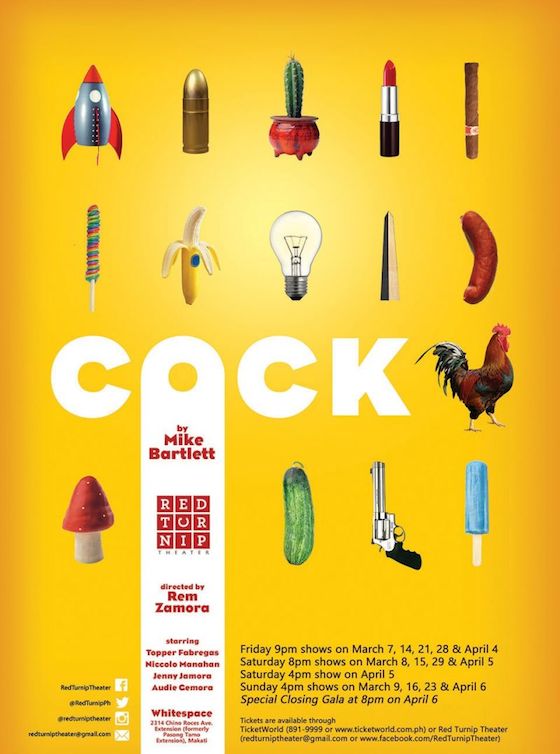
Cock poster via Red Turnip Theater.

The years  (limited as it is) have provided me with a sense of these limitations. With nary the budget for the grandness of musicales, and sometimes the lack of imagination for sets that actually work, what we do always have and consistently is the talent.

And then of course, there is Cock.

(more…)

PROBABLY the worst kind of deception is the one cloaked in what should be the more respected labels of media and journalism. In the Philippines, a media organization commits the worst beauty deception. Because while it wants to discuss gender equality and women’s issues —which certainly it should—it does so with the help of . . . tadah! a beauty product.

It would be hilarious if it weren’t so irresponsible.

From product commercial to media project

This decision of Rappler to partner with the multinational shampoo brand Pantene in a #WhipIt series is highly problematic especially because it fails to discuss the more complex issues related to beauty and advertising, and being Pinay at this point.

This is not to say that a media enterprise and a beauty product cannot come together to cooperate on a project. But a purportedly critical and objective media enterprise cannot and should not do it, because it’s a finger pointed at its own biases for a particular product, its own perception of what is important given its partnership with a given shampoo brand.

Which is to say that were Pantene, in fact, a shampoo brand that celebrated diverse hair types and styles, that spoke not just of long straight shiny hair as the ideal, then Rappler giving it mileage by working with it wouldn’t be so bad. That would make it a media enterprise that intervenes in the dominant discourse of beauty, instead of reinforcing the unkind because un-natural look and feel of hair for a majority of Pinays.

Of course, Rappler might have been confused for a moment about Pantene. After all, they were kicking off from a commercial advertisement that got such mileage online and globally because it dared talk about how men and women continue to be treated differently, as proven by the condescending or judgmental labels against women when they do what men do: bossy versus boss, pushy versus persuasive, vain versus neat. In the end, the commercial asserts: Don’t Let Labels Hold You Back, Be Strong and Shine #ShineStrong #WhipIt.

That’s some ad copy. And that is all that it is. But Pantene will have us believe otherwise, and Rappler is just complicit in this product’s reconfiguration of woman power, all of which remain premised on its task of selling shampoo and the long shiny straight black hair that rarely exists naturally for the Filipina. (more…)
Activism, to me, has always been about daring to ask the more difficult questions. And wanting to do – and actually doing – something about it.

Anyone who thinks Kristel is being used for the cause of free education was obviously blind and deaf to the years of protests against tuition fee increases and the repercussions of the slow process of the State ceasing to subsidize state colleges and universities. So no, Kristel is not some mascot being used for this cause; Kristel is but proof that this cause is a valid one to take on, to engage in. Kristel proves that the current system kills, the spirit and otherwise. (more…)

When I entered the State University as a freshman in 1995, I was part of an English block that was diverse by virtue of class. It didn’t take long to find that while some of us were from well-off families (I had a Romualdez in my class for example, and there were children of lawyers), and there were some of us who were versions of middle class; many of my blockmates came from poorer families, many from the provinces. Many of them, I later found, were dependent on scholarships, mostly from elsewhere other than the State U.  (more…)

I tell this story to any Pinay younger than me: there was a time when there were no billboards on EDSA, no advertisements for skin whitening or beauty clinics, no celebrities shamelessly selling everything from flawless skin to flat bellies, big boobs to silky straight hair.

This story is one that’s about difference, one that I hope will remind them of the superficiality of this current landscape of being Pinay, one that’s being enforced by mass media. It’s also always a reminder of how many steps back being woman in this country has taken, how many more steps back because of celebrity culture, and how many more steps into the dark ages because we are clueless about how to handle it.

Elsewhere in the world, the stand on fakery and Photoshopped photos, on whitening and plastic surgery is critiqued by celebrities, politicians, members of the media themselves. In this country, everyone’s in on deceiving generations of Pinays about beauty. (more…)